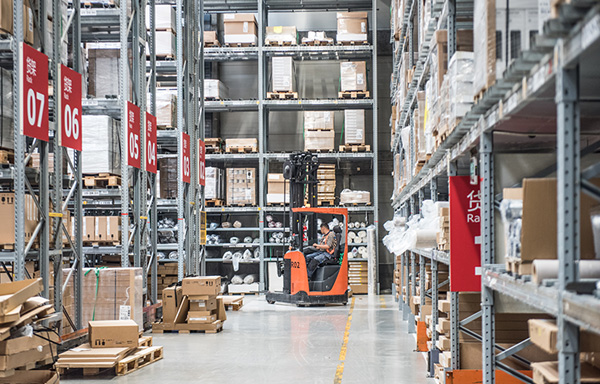
Shuttle-based automated storage handles totes, trays, cartons and individually bundled goods. It can provide temporary storage for order assembly, buffers for goods-to-person operations and automated replenishment for picking modules, particularly where product ranges are large or change frequently.
Features and advantages
- The article describes configurations with handling capacity more than ten times that of a conventional warehouse.
- Multi-level shuttle layouts can make use of available space above and below obstacles and near the top of a building.
- Goods of different sizes can use flexible storage locations after suitable packaging; links between levels help increase storage density.
- Goods can arrive at picking or palletising stations in the required sequence, with shuttle modes suited to different load sizes.
- Interchangeable transport units support replacement, while aisle work platforms provide access for operation and maintenance.
- Additional shuttles can be introduced at individual levels to increase throughput.